
Hiring from Your Own References Can Be Fatal for a Startup
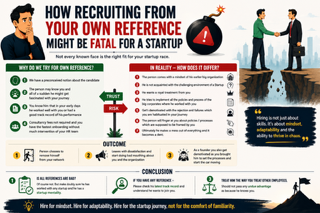
As founders, we often believe that hiring someone from our own professional network is one of the safest decisions we can make.
After all, we know the person. We’ve worked together. We’ve seen their capabilities. We trust them.
Over the years, however, I’ve learned that this assumption can become one of the costliest mistakes a startup founder makes.
This realization didn’t come from reading management books. It came from building teams, making hiring mistakes, and understanding that startups demand a completely different mindset than large organizations.
Why We Naturally Prefer Hiring Through References
When we recruit someone we already know, our decision is often influenced by familiarity rather than suitability.
We already have a positive impression of the individual.
Perhaps they worked with us in a previous organization and consistently delivered excellent results. Their past performance gives us confidence that they will succeed again.
Sometimes, they become inspired by our entrepreneurial journey and express a genuine interest in joining our startup. As founders, this enthusiasm feels reassuring.
There are also practical advantages. Hiring through references saves consultancy costs, reduces recruitment time, and allows faster onboarding with minimal HR intervention.
Everything appears efficient.
But startups rarely reward assumptions.
Where Things Begin to Go Wrong
The biggest challenge is not capability.
It is mindset.
Many experienced professionals come from highly structured organizations where systems, policies, departments, and resources already exist.
A startup operates in a completely different environment.
Every day brings uncertainty.
Every week demands adaptation.
Every month requires solving problems that have no predefined solutions.
Someone who has spent years working within established systems often unconsciously expects the same environment inside a startup.
That expectation creates friction.
Some expect preferential treatment simply because they know the founder personally.
Others begin comparing every process with the company they previously worked for.
Instead of adapting to the startup, they try to recreate the corporate structure they left behind.
Unfortunately, early-stage startups cannot afford unnecessary bureaucracy.
They need execution far more than documentation.
The Startup Reality
Entrepreneurship teaches us to become comfortable with rejection.
Clients reject proposals.
Investors reject pitches.
Ideas fail.
Hiring decisions fail.
Products require constant iteration.
Founders develop resilience because they have no alternative.
Not everyone is prepared for this journey.
Professionals accustomed to predictable environments often become demotivated when they encounter continuous uncertainty, frequent failures, and changing priorities.
Instead of helping solve problems, they begin pointing out what is missing.
Policies are incomplete.
Processes are undefined.
Reporting structures are evolving.
Ironically, these are exactly the problems a startup is trying to solve while growing.
Founders need builders.
Not spectators.
The Hidden Cost
When such hiring decisions fail, the consequences extend beyond one resignation.
The employee often leaves disappointed.
Relationships become strained.
Sometimes, the individual distances themselves from the founder professionally and personally.
In some cases, dissatisfaction turns into negative conversations about the founder or the organization.
For the founder, the emotional impact is equally significant.
You hired someone believing they would strengthen the company.
Instead, you lose time, momentum, trust, and confidence.
For an early-stage startup, these losses are often more expensive than the salary itself.
Are References a Bad Idea?
Absolutely not.
Some of the finest leaders I’ve worked with have joined through trusted references.
The difference is not the source of hiring.
The difference is the mindset of the individual.
Before hiring through your network, ask yourself:
- Has this person worked in a startup before?
- Can they thrive without established systems?
- Do they enjoy creating solutions rather than waiting for instructions?
- Have I evaluated their recent track record instead of relying on memories from years ago?
- Are they joining because they believe in the mission—or simply because they know me?
These questions matter far more than familiarity.
One Rule Every Founder Should Follow
A referred employee should never receive special treatment.
The same hiring standards.
The same performance expectations.
The same accountability.
The same growth opportunities.
Professionalism must always come before personal relationships.
When founders create exceptions for familiar faces, they unintentionally weaken the culture they are trying to build.
Final Thoughts
Building a startup is one of the most demanding leadership journeys anyone can undertake.
It requires people who are comfortable with ambiguity, resilient through setbacks, and passionate about building something that doesn’t yet exist.
Experience certainly matters.
Skills certainly matter.
But mindset matters even more.
The next time a trusted friend, former colleague, or professional acquaintance expresses interest in joining your startup, don’t hire because you know them.
Hire because they have demonstrated that they can thrive in the unpredictable world of entrepreneurship.
Because in a startup, familiarity doesn’t build companies.
The right mindset does.
— Manoj Maity
Founder & Managing Director, MAITYS